How today's consumers are shopping for dazzler products in the midst of the COVID-19 pandemic, according to responses of 10,000+ shoppers.
The PowerReviews Changing Face of the Beauty Shopper Written report draws on survey responses from 10,646 agile beauty consumers across the country. Cardinal findings include:
Beauty spending has shifted online
-
87% say they spend more or the aforementioned online than before Covid
-
49% say they now spend more $50 online on beauty products; compared to sixteen% than when we asked this same question in 2019
-
57% of shoppers say that they had never tried more than of a quarter of the beauty products they bought online in 2020 (i.e. they were showtime time purchases)
-
However, in-store dazzler spending at this level has too increased: 41% say they now spend more than $50 in shop, compared to 21% in 2019; 55% also say they use curbside pick-up more than before the pandemic
User Generated Content (i.e. Ratings & Reviews) is CRITICAL regardless of shopping channel and has increased in importance
-
99% e'er or sometimes read ratings and reviews when shopping for dazzler products online, same effigy for in-shop shoppers is 85%
-
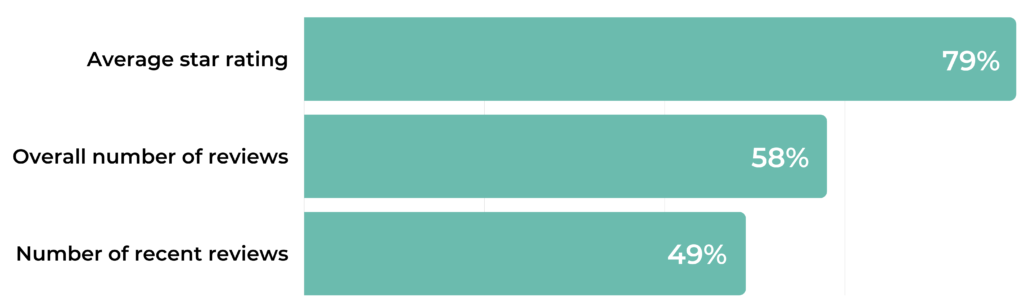
79% focus on average star rating, 58% care about overall book of reviews and 49% say they look for recent review content.
-
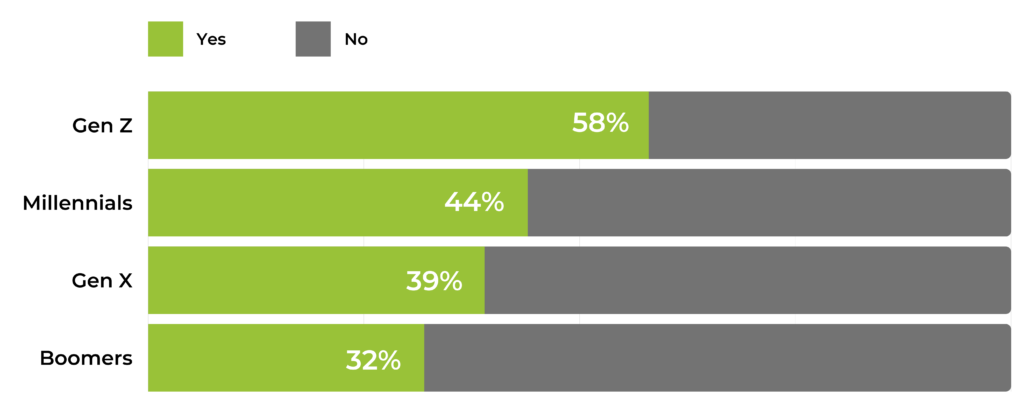
41% say they rely on reviews more than than they did pre-Covid. This is most prominently the case among younger generations, with 58% of Gen Zers claiming this to be the case.
-
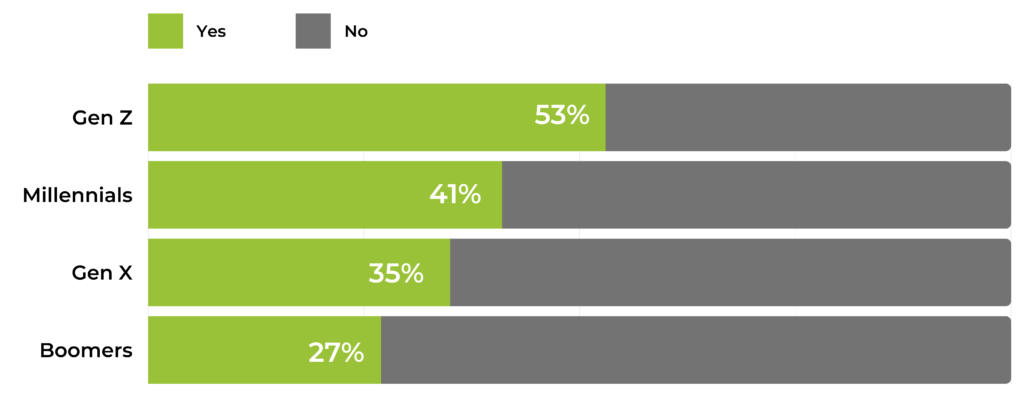
User-generated imagery and video is as well key, with 38% saying it's more important than earlier the pandemic (again this figure is highest among Gen Zers at 53%)
Social and political issues are likewise at present significantly impacting shopping behaviors:

In the by, when a shopper was in the market place for a beauty production such as lipstick, mascara or moisturizer, they'd drive to their neighborhood drug store or pay a visit to a beauty counter at a local department store. And when they did, they'd notice shelves dominated by products manufactured by a relatively small number of legacy brands.
Merely that'due south no longer the case. The way consumers store for beauty products is constantly evolving — a procedure supercharged past the Covid pandemic.
A growing number of consumers at present purchase beauty products online. This has inevitably led to an increased dependence on user-generated content every bit shoppers seek validation for their purchases.
What's more, new beauty brands and products seem to emerge daily. And the criteria shoppers employ to make purchase decisions is evolving; increasingly, shoppers seek out brands and products that align with their values.
Simply when it seemed businesses finally had a handle on the shopping habits and preferences of beauty shoppers, Covid hit. The global wellness crisis has had a huge (and lasting) impact on just almost every facet of life — including the way we shop.
Dazzler brands and retailers must adapt their plans and strategies to effectively reach and convert today's shoppers. And there's plenty of opportunity for those that practise. Co-ordinate to a study from Fior Markets, the global beauty and personal care products market was $493 billion in 2018. Past 2026, it'southward expected to reach $756 billion.
In lodge to develop effective strategies, though, brands and retailers must first empathise how consumers are shopping for beauty products — and how the global health crisis has shaped these habits.
Recently, PowerReviews surveyed ten,646 consumers to shed light on the shopping habits and preferences of those purchasing beauty products — specifically makeup and skincare items. Nosotros also aimed to understand how beauty shopping habits have changed since 2019, when we fielded a similar survey .
This report will share the key findings of our inquiry — every bit well every bit practical, impactful actions beauty brands and retailers can accept to meet (and exceed) the expectations of today's beauty shoppers…and boost their bottom line.

Impact of Covid on Consumers' Dazzler Habits
The pandemic has turned peoples' lives upside down. Many people are working from home — while simultaneously supervising their childrens' eLearning. And the vast majority of vacations and events have been cancelled — at least for the fourth dimension beingness.
These lifestyle changes take led to changes in beauty habits, too. For example, many consumers are cut back on makeup use, likely because they're non leaving the house every bit much.
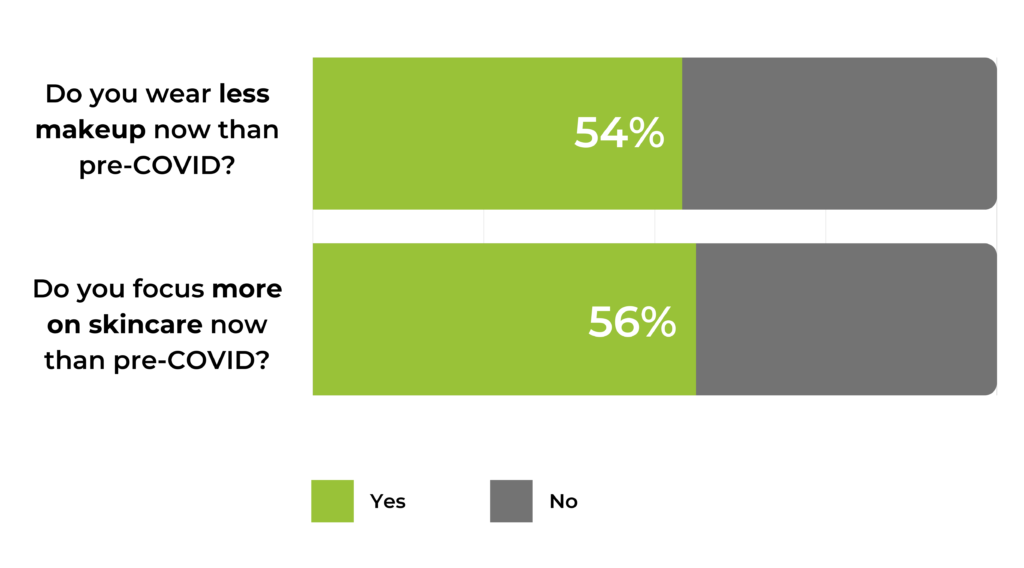
In fact, our survey found that more than one-half (54%) of consumers bespeak they wear less makeup now than pre-COVID.
On the other mitt, information technology seems many consumers are making skincare a priority. More than one-half (56%) bespeak they're more focused on skincare now than they were before the pandemic.
People are spending more time at home, which means they may have more time to devote to more thoroughly caring for their skin.
The pandemic has had a negative financial impact for many consumers. According to the Department of Labor, the U.S. unemployment rate was six.vii% in Dec 2020.
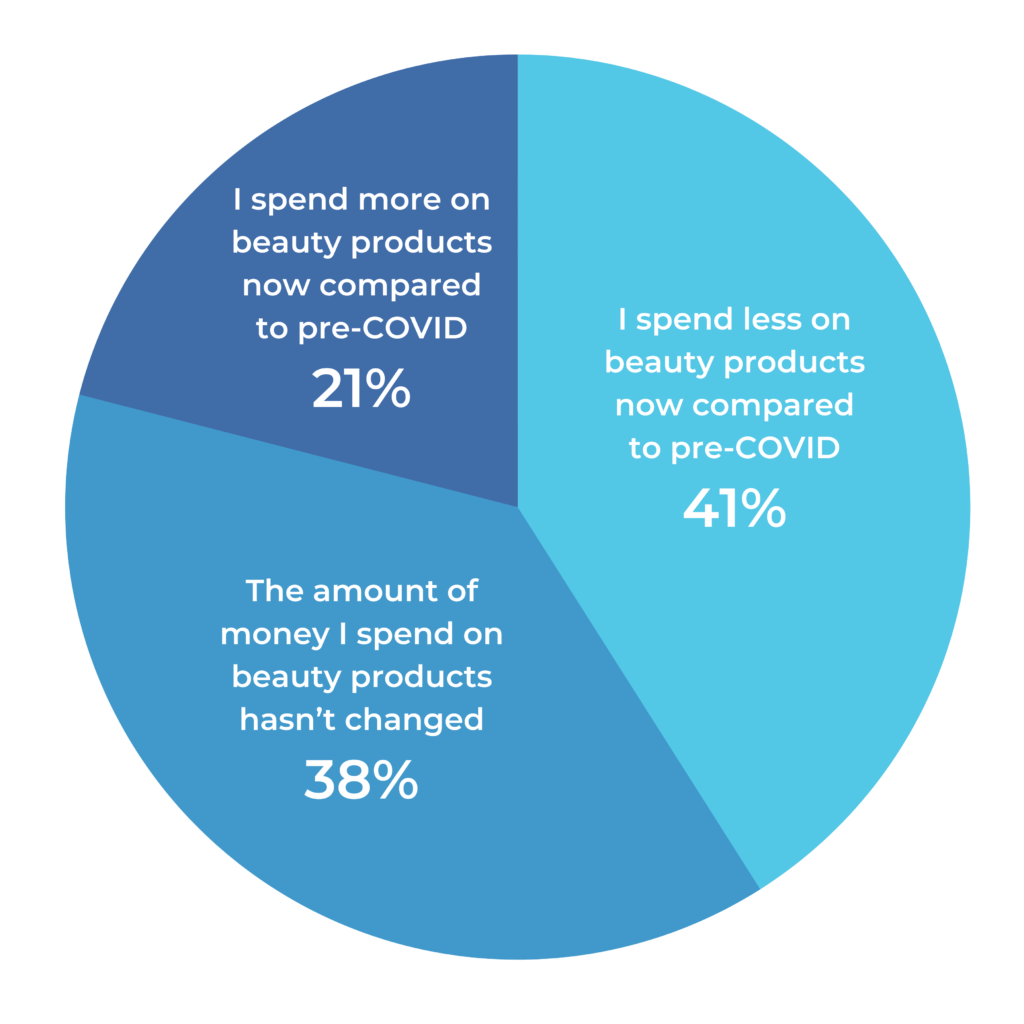
With and so many unemployed (and underemployed) people, it's not surprising that 41% of consumers say they spend less money on beauty products now than before COVID. Over a third (38%) bespeak their dazzler spending hasn't been impacted past COVID, and the remaining 21% say their beauty spending has actually increased .
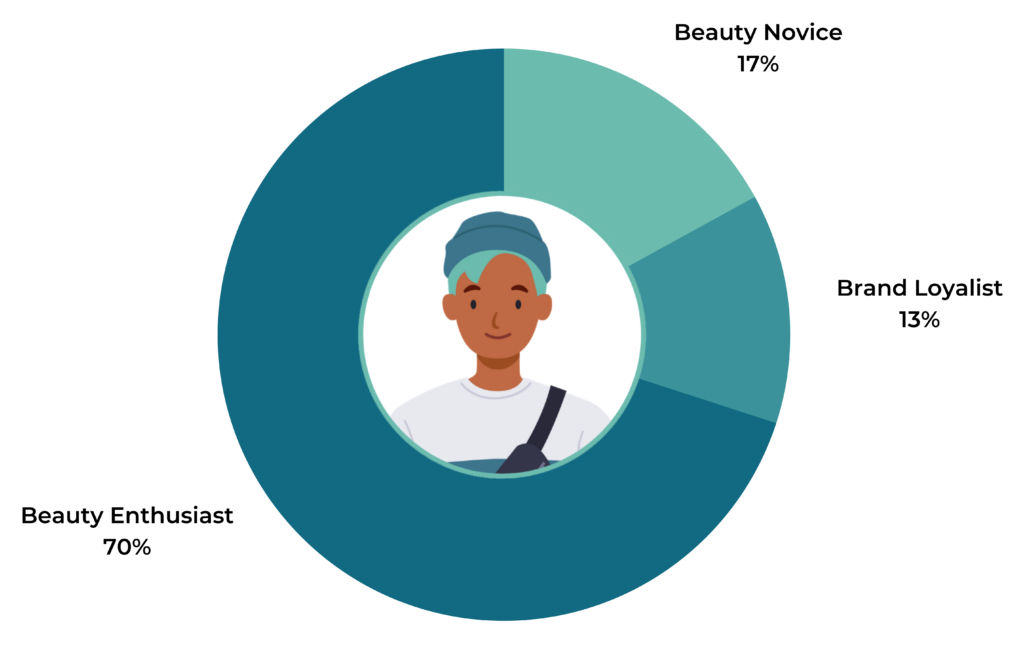
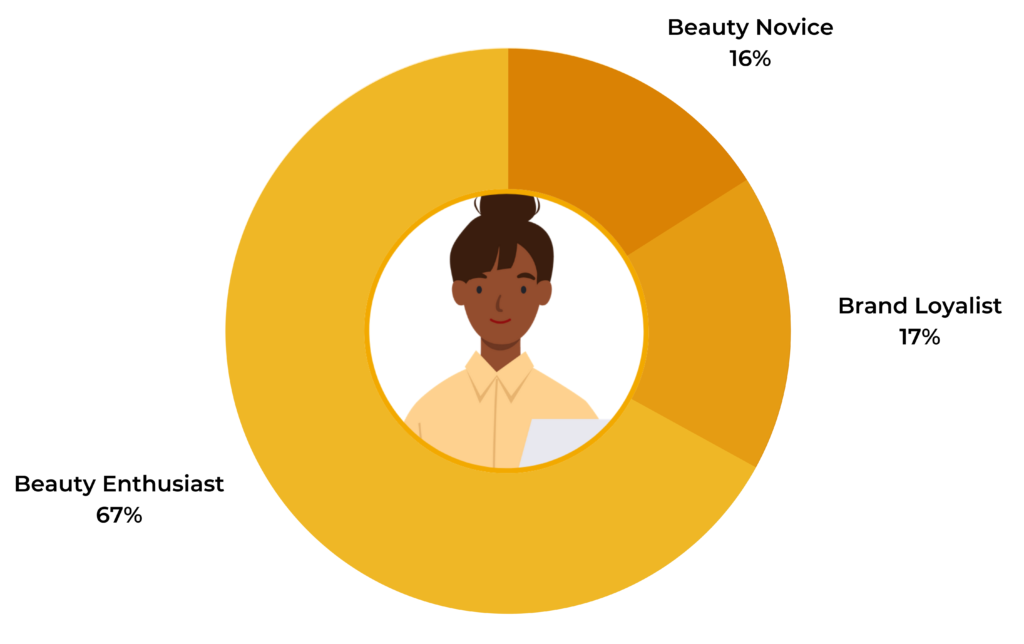
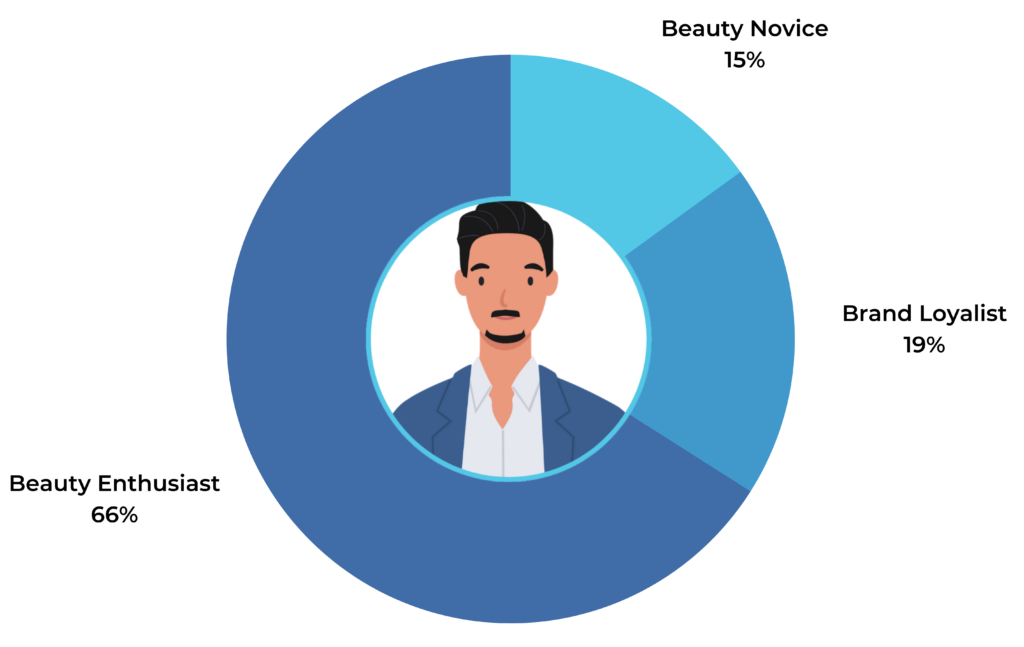
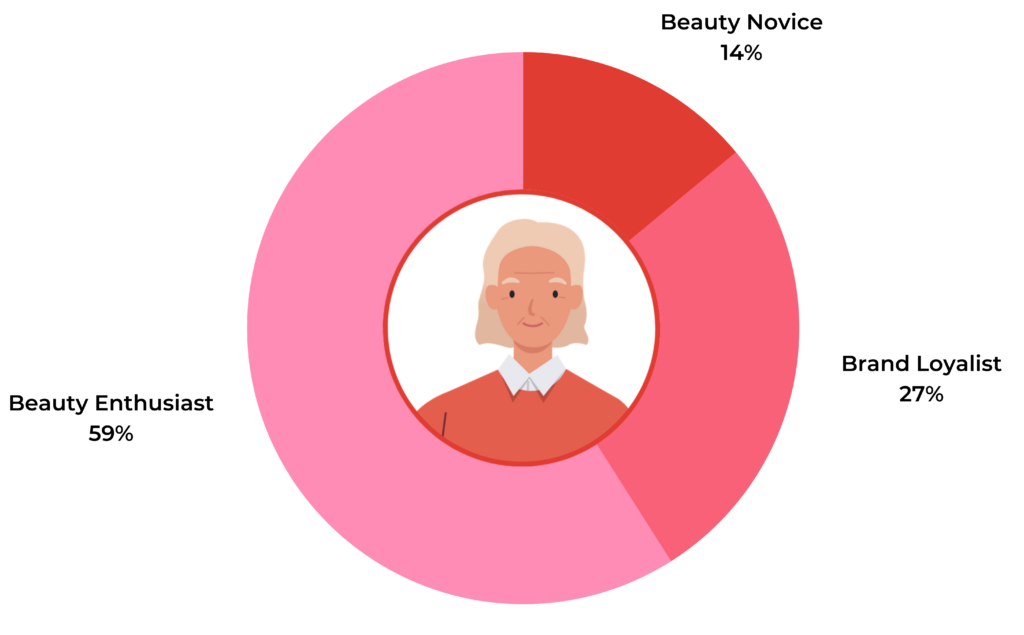
Beauty enthusiasts are the least likely to have decreased their beauty in the midst of COVID (and most probable to take increased spending), when compared to beauty make loyalists and beauty novices.
Income likewise seems to impact whether shoppers take decreased their beauty spending — but perhaps non as much as expected. Those making higher incomes are merely slightly less likely to accept cutting beauty spending post-COVID than those with smaller incomes.
| I spend less coin on beauty products now than earlier COVID | I spend more money on beauty products now than before COVID | The amount of money I spend on beauty products has non changed |
| $0 – $25,000 | 44% | 18% | 38% |
| $26,000 – $50,000 | 42% | 20% | 38% |
| $51,000 – $75,000 | 39% | 21% | xl% |
| $76,000 – $100,000 | 38% | 23% | 39% |
| $100,000+ | 38% | 24% | 38% |
| Prefer not to say | 43% | 16% | 41% |
Where Consumers Shop for Beauty Products
There's been a well-reported uptick in eCommerce shopping since the start of the COVID-19 pandemic. So it'due south probably no surprise that a growing number of shoppers are purchasing dazzler products online, too.
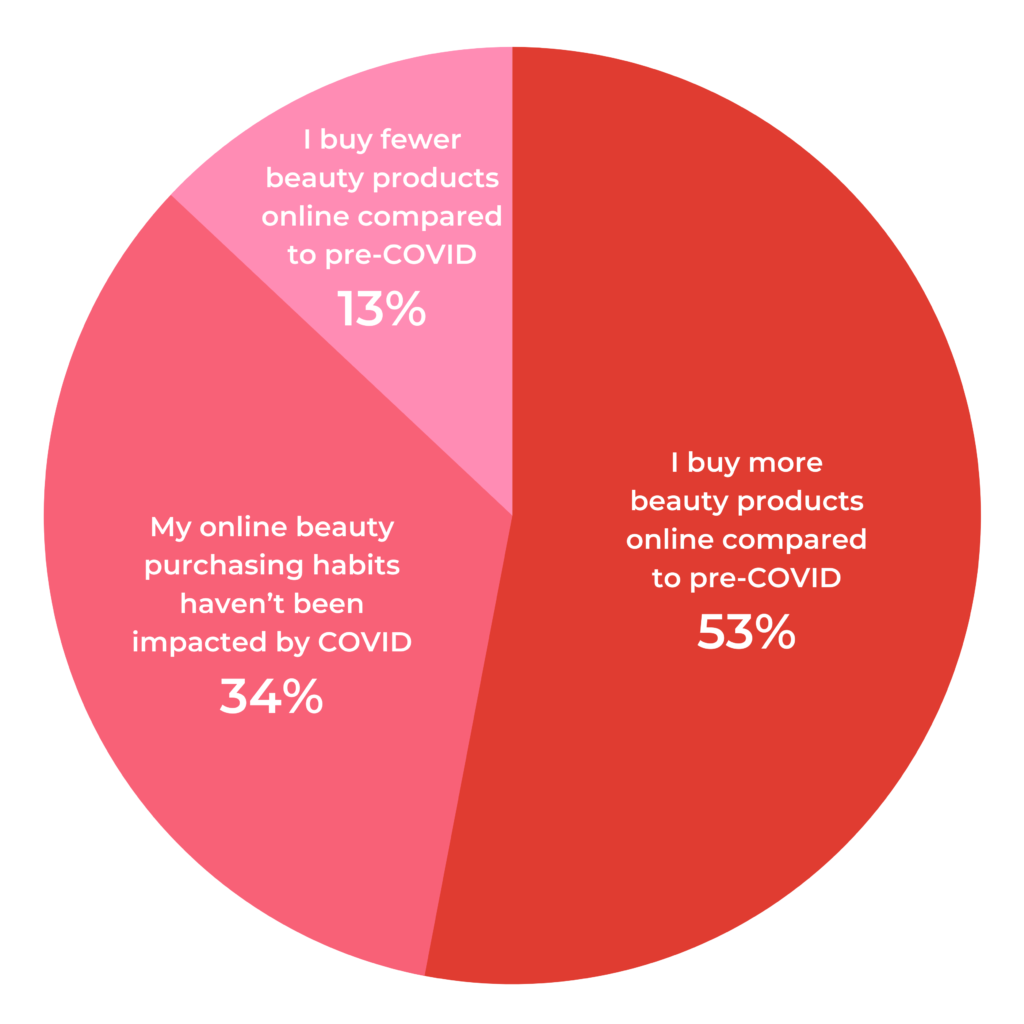
More than than half of shoppers (53%) buy more beauty products online now, compared to pre-COVID. This number is fifty-fifty college amongst younger consumers. 66% of Gen Z shoppers and 58% of Millennials say they spend more online on beauty products at present than they did before the pandemic.
Also of note, 60% beauty enthusiasts are spending more online now, compared to 39% of dazzler brand loyalists. What's more, those with incomes of $100,000 or higher are more likely to have increased online dazzler spending than their lower-income counterparts.
| I purchase less dazzler products online now compared to before COVID | I purchase more beauty products online now compared to earlier COVID | My dazzler purchasing habits have non changed |
| $0 – $25,000 | 18% | 43% | 39% |
| $26,000 – $fifty,000 | 13% | l% | 37% |
| $51,000 – $75,000 | 11% | 56% | 33% |
| $76,000 – $100,000 | 11% | 49% | 40% |
| $100,000+ | eleven% | 62% | 27% |
| Prefer not to say | 14% | 47% | 39% |
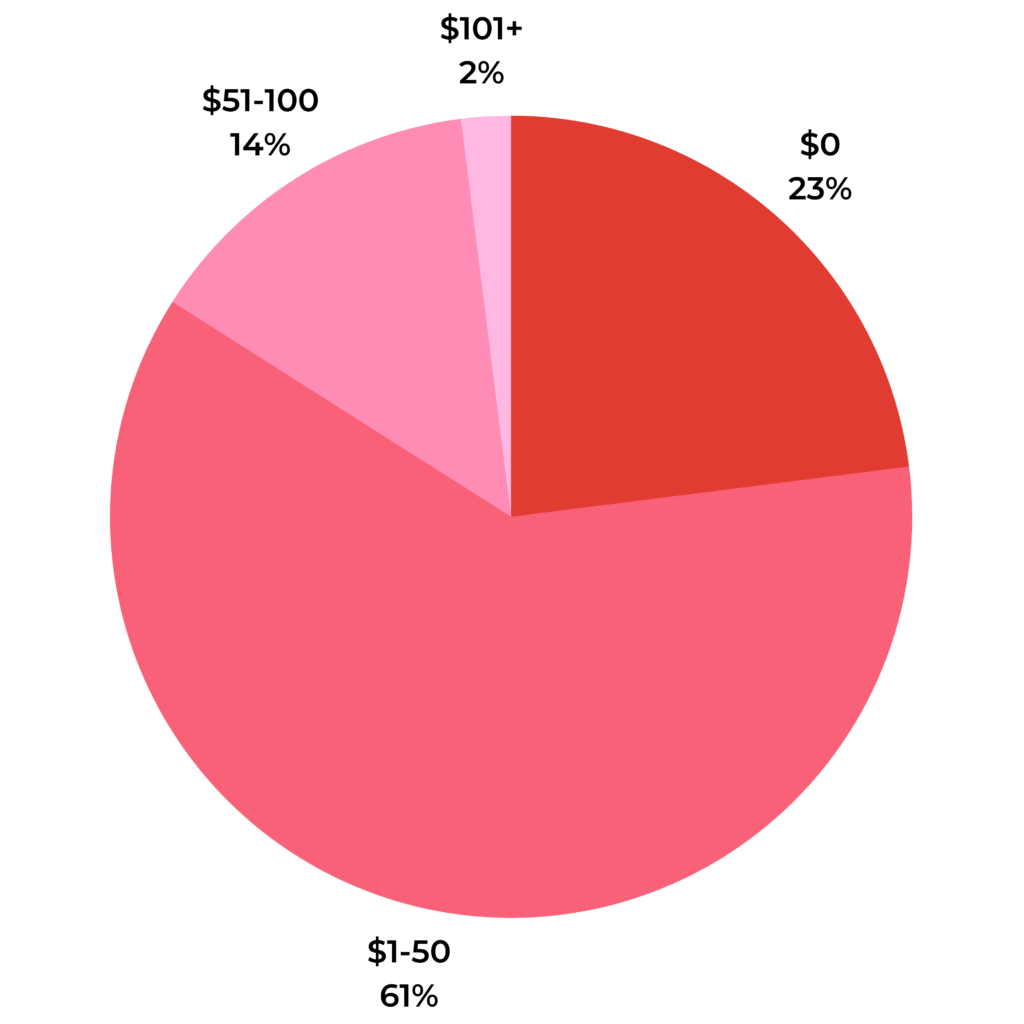
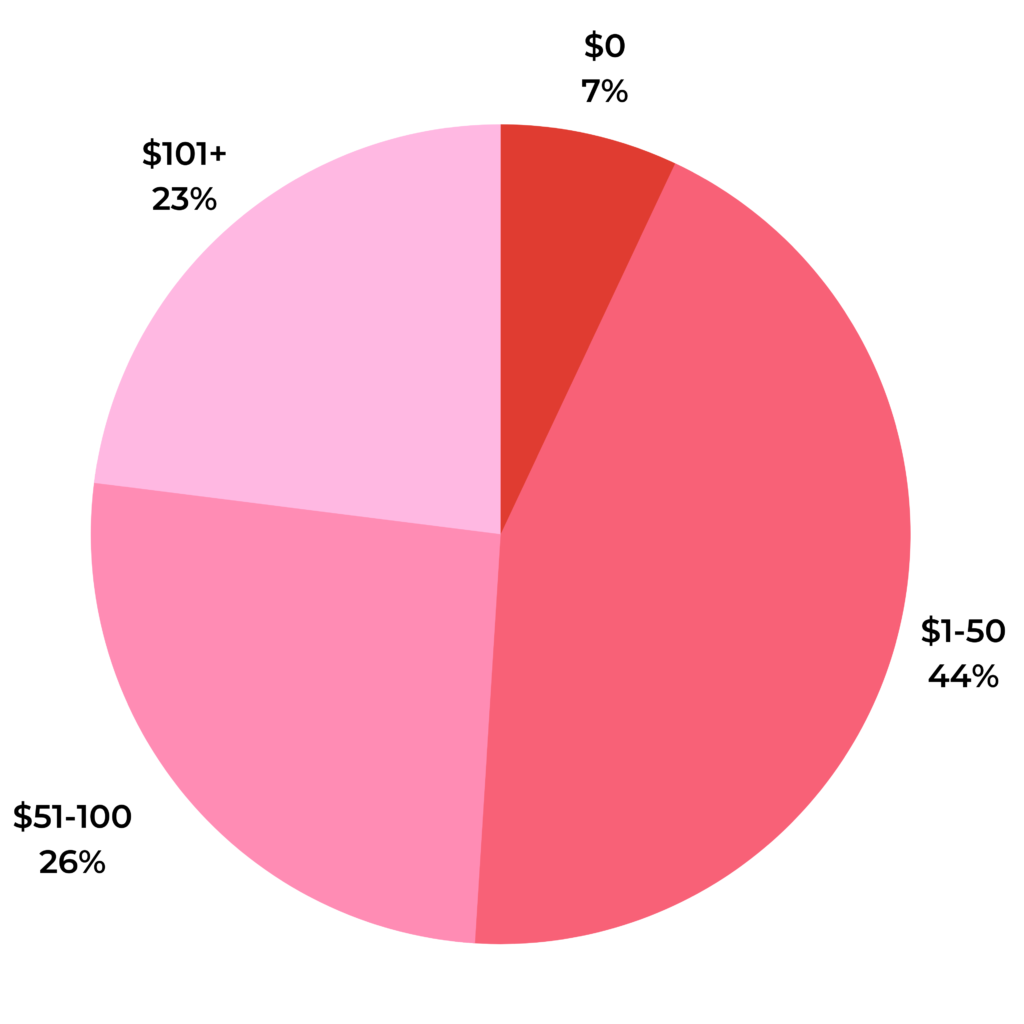
We besides asked consumers to indicate how much they spend each month on online beauty purchases. And as it turns out, they're spending significantly more each month compared to merely a few years ago when we asked consumers the same question. For example, in 2019, just 2% of respondents indicated they spent more than $101 per month on online beauty purchases. In 2021, that number has grown to 23%!
When it comes to online shopping, there are nearly countless options. And then where do online shoppers most often start the purchase journey for beauty products?
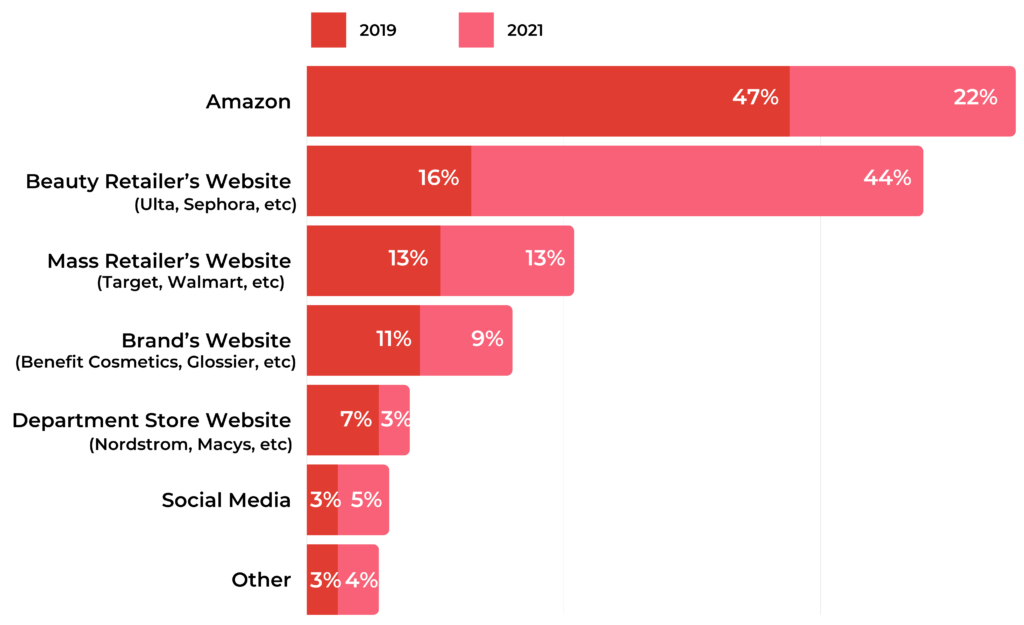
The starting betoken of virtually half (44%) of shoppers is a beauty retailer's website — call back Ulta.com or Sephora.com. Amazon is a distant 2nd, with 22% of shoppers indicating its where they start the online purchase journey for beauty products.
Information technology'due south worth noting that when we asked this same question but two years agone, 47% of shoppers indicated they typically start shopping on Amazon. This suggests that Amazon has become less of a threat to dazzler retailers.
And by providing great online shopping experiences, information technology's very much possible for beauty businesses to compete (and win) against the eCommerce giant.
Brand no mistake: the ascent in dazzler eCommerce doesn't mean stores are dead.
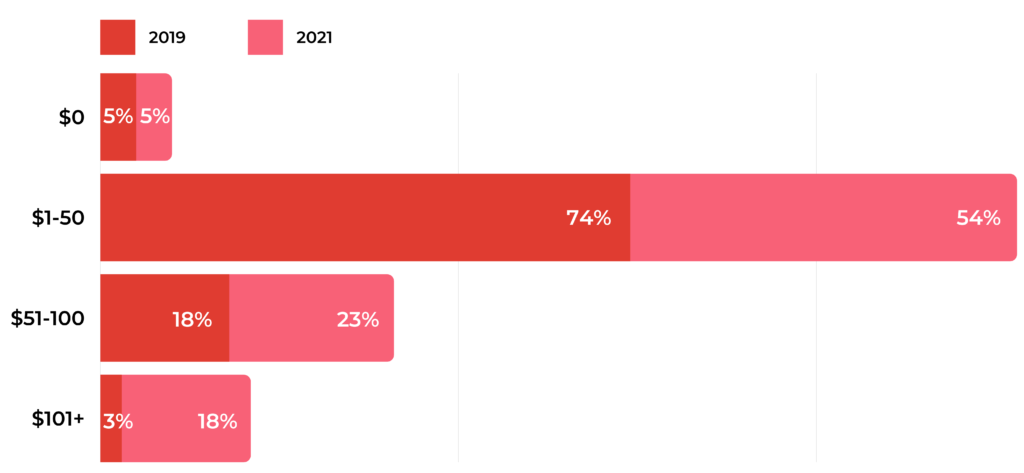
In fact, our data tells us that the amount consumers spend on beauty products in stores each month has actually increased from 2019.
For example, in 2019, during any given month, just 3% of consumers spent more than $101 in a shop on beauty products. In 2021, that number grew to eighteen%.
A central finding of this research is that stores remain a popular place to buy tried-and-true products — and notice new ones. We'll explore this in more than item later in this written report.
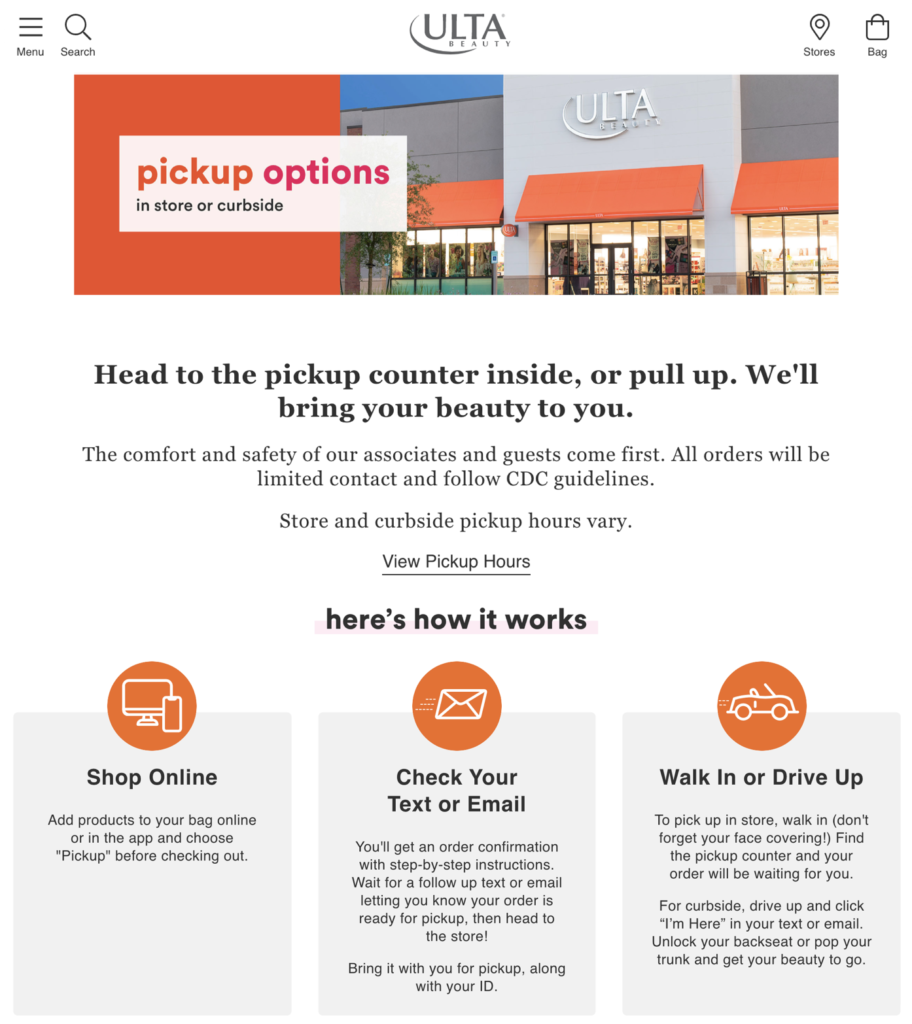
Curbside pickup — also known as Purchase Online Pick up in Store (BOPIS) offers shoppers the best of both worlds. They can browse online and minimize in-person contact — but still enjoy the (nearly) instant gratification of in-shop shopping.
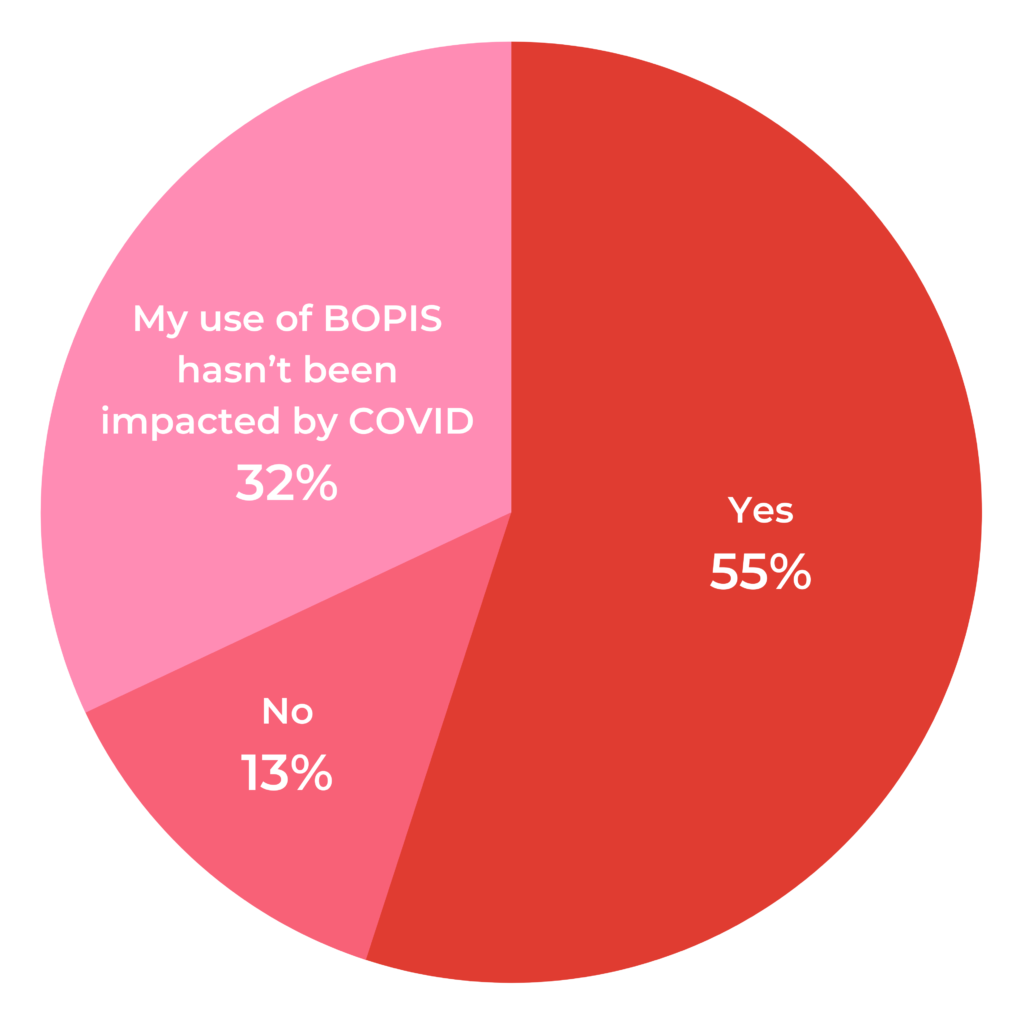
The popularity of BOPIS has grown significantly among beauty shoppers. In fact, 55% say they utilise curbside pickup for beauty products more at present than they did pre-pandemic.
Younger generations are taking advantage of curbside pickup fifty-fifty more. 60% of Millennials and 58% of Gen Z shoppers say they've ramped upwardly their use of BOPIS services for dazzler products.
The Function of UGC in Beauty Shopping
User-generated content — including reviews, Q&A, photos, and videos — has a big affect on purchase decisions. That'southward not exactly news.
But thanks to this survey, we can at present clearly meet that for beauty shoppers, this content has never been more important.
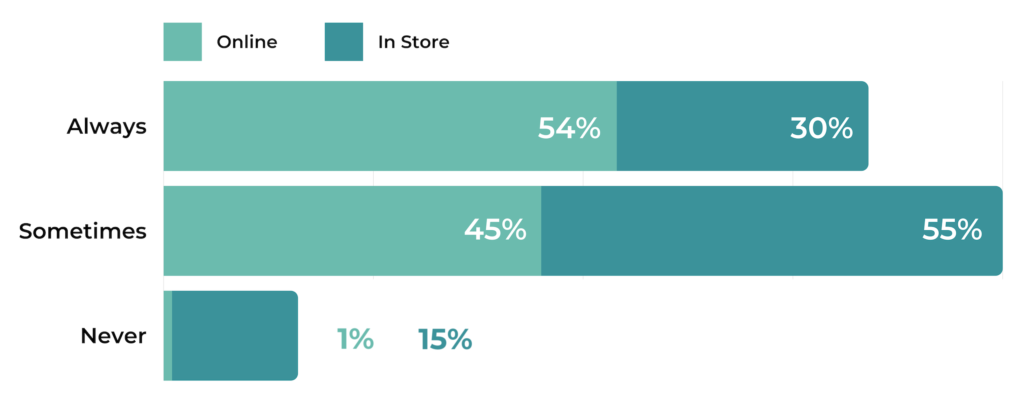
Our research constitute that all shoppers (99%) read reviews at least sometimes when shopping online for beauty products, with 54% saying they always practise so.
Reviews thing for in store shoppers, too. 85% say they read reviews at least sometimes when shopping for beauty products within the four walls of a brick and mortar store.
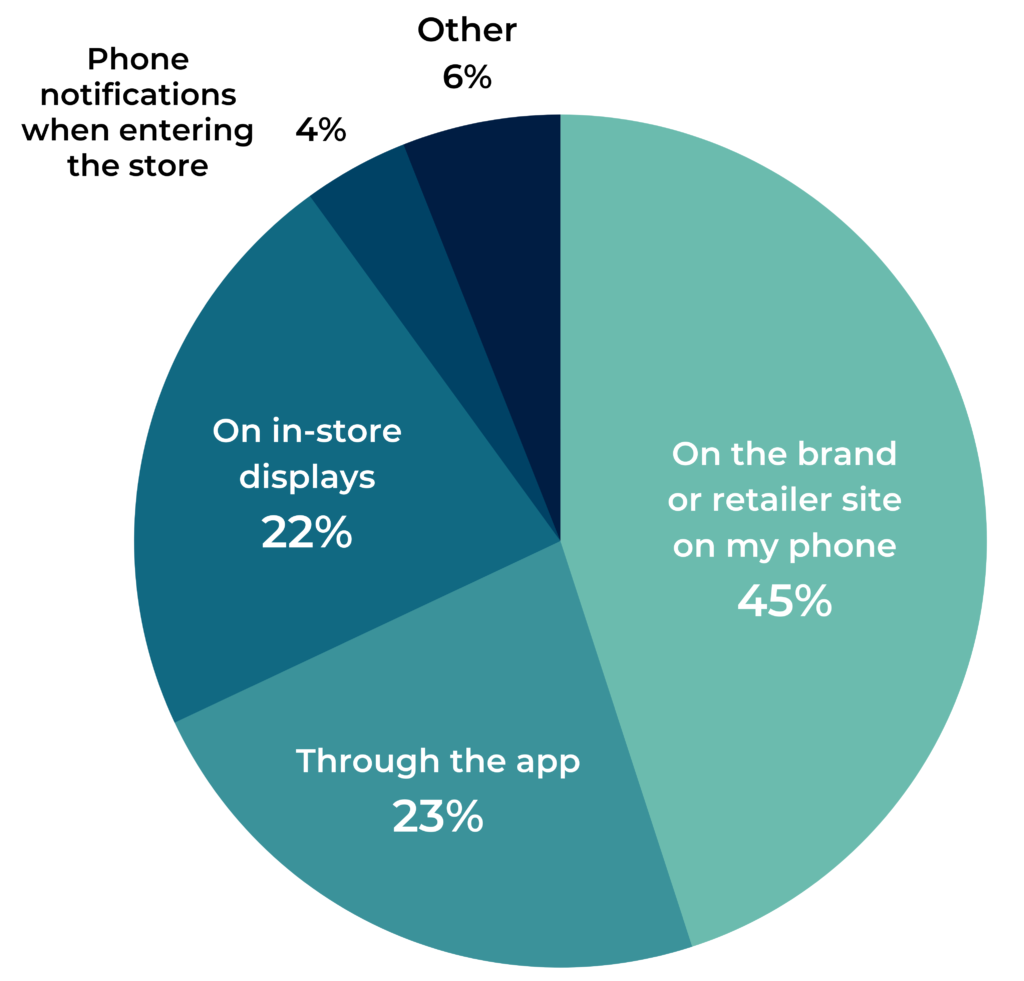
How practise they want to access reviews when shopping in a store? Nearly one-half (45%) prefer to observe reviews by visiting the brand or retailer's website on their phones.
The bulletin hither? Ensure your reviews are easy for shoppers to find and consume — regardless of device.
What elements of reviews exercise dazzler shoppers value when making buy decisions?
79% say the average star rating is of import. More than half (58%) care about the overall number of reviews for a product. And 49% say the number of contempo reviews is important. Notation: respondents could select all that applied.
This highlights the importance of consistently generating a steady stream of great reviews.
It seems shopper dependence on reviews has only grown in the midst of the COVID-19 pandemic. 41% of beauty shoppers indicate they're more reliant on ratings and reviews now than they were before the beginning of the global health crisis. This number is fifty-fifty higher — 58% — amidst Gen Z shoppers.
Beauty products are highly personal purchases. While a children's toy will look the same regardless of who buys it, a makeup item will look unlike on every person.
Customer-submitted photos and videos help shoppers empathise what a beauty product will await like on someone like them. During Covid, user-submitted visual content has become even more important.
Just over a tertiary (38%) of those nosotros surveyed say they are more reliant on user-submitted visual content now, compared to pre-Covid. This number soars to 53% amidst Gen Z shoppers. Conspicuously, these younger consumers accept an ambition for user-submitted photos and videos.
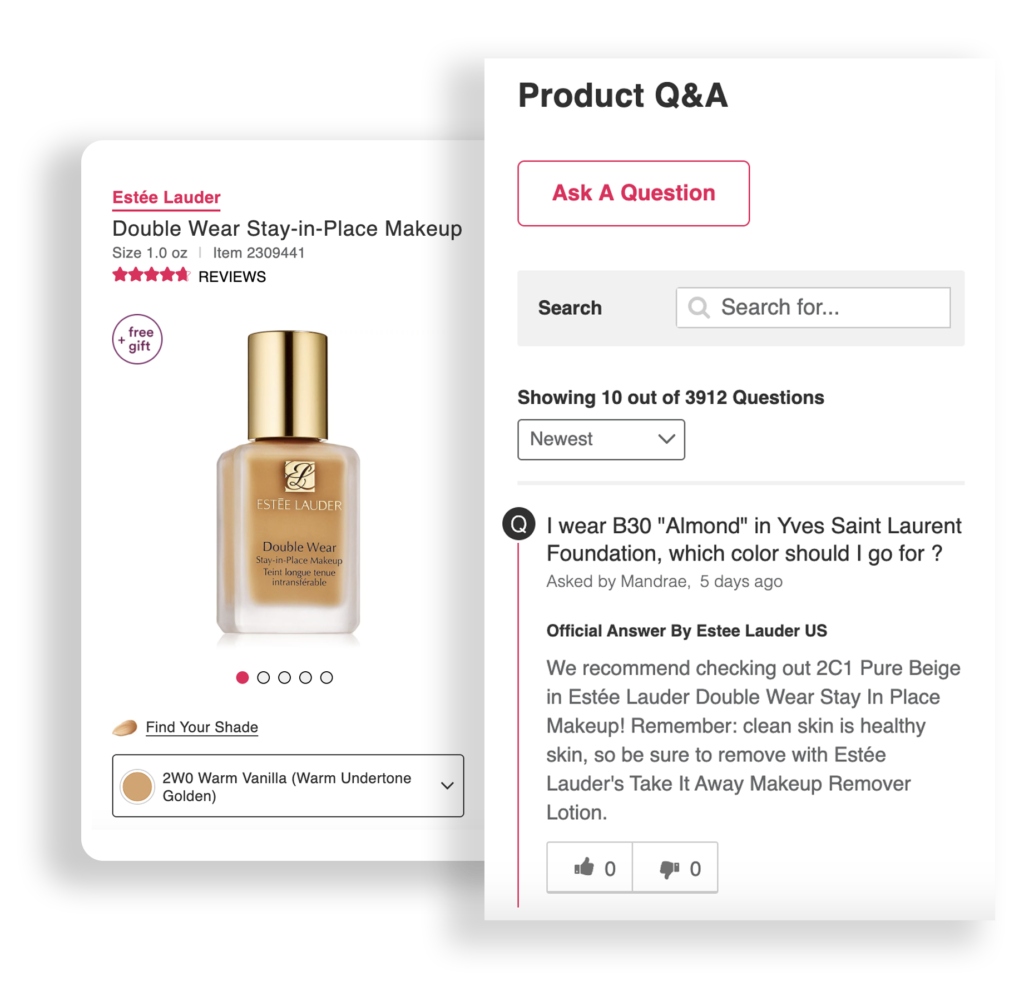
When a consumer is shopping in a brick-and-mortar store and has a question nigh a beauty product, they can ask an in-store acquaintance. Just when they're shopping online, they often turn to the product's Q&A (and as we mentioned earlier, consumers are shopping online a whole lot more than these days).
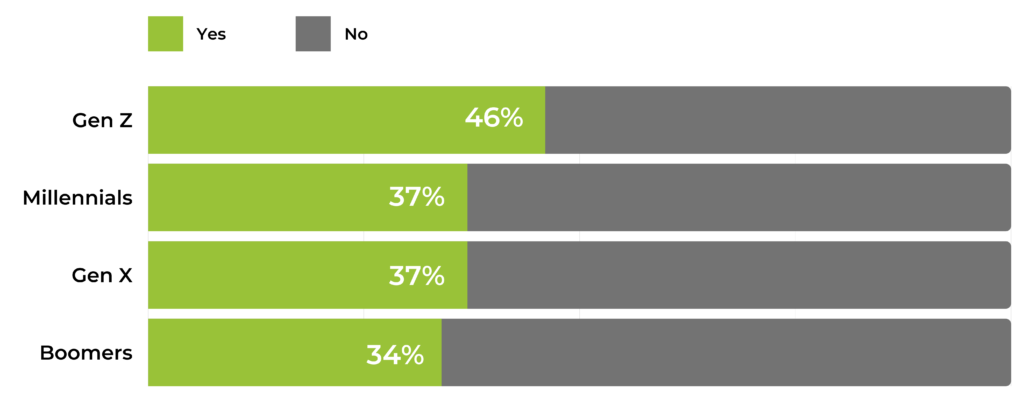
So it'southward probably not surprising that over a third (36%) of beauty shoppers say they're more than reliant on Q&A now than pre-COVID. Gen Z is the generation with the largest increase in dependence on Q&A. Well-nigh half (46%) say they depend on this content more now than they did before COVID.
How Shoppers Restock on Tried-and-True Dazzler Products
There are beauty products that a given consumer will plow to time and time over again. Perchance information technology's a foundation that perfectly matches a shopper's skin tone — or possibly it's an centre cream that instantly makes them look like they got a solid viii hours of slumber.
Let'south accept a closer look at how consumers shop for these tried-and-truthful dazzler products.
Consumers accept countless shopping options. But when information technology comes to shopping for beauty products they've tried before, a few of those options ascension to the height.
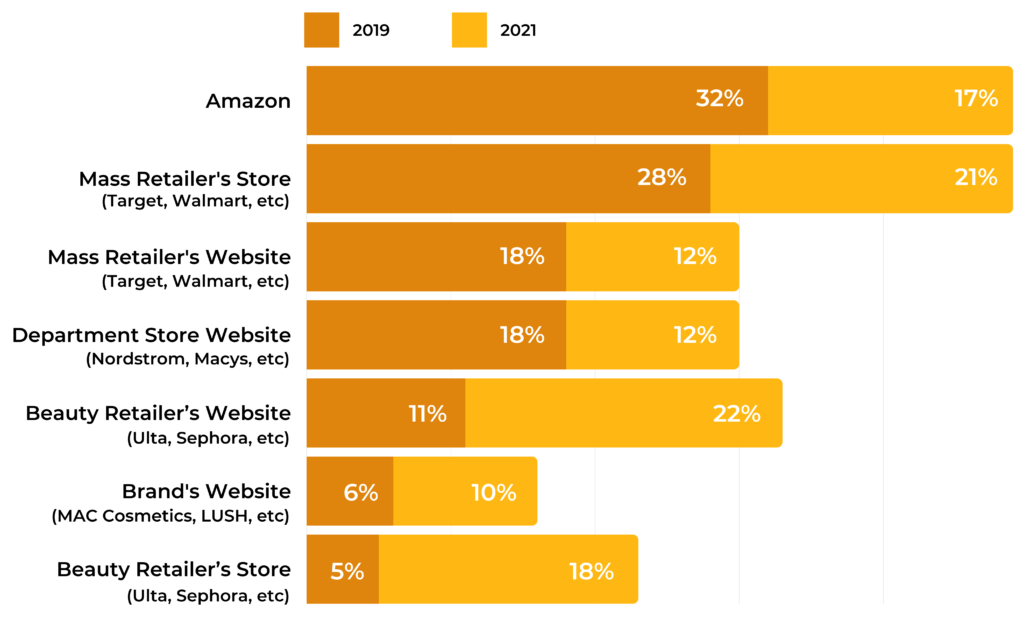
Nearly a quarter (22%) volition buy on a specialty beauty retailer's website, and 21% will opt for a mass retailer's store — such as Walmart or Target. Some other 18% volition buy at a specialty beauty retailer'due south store and 17% will buy on Amazon.
Other less popular spots for stocking upwards on tried-and-true beauty products include mass retailers' websites (12%) and brands' websites (10%).
Interestingly, the popularity of speciality beauty retailer stores and websites — also as brand websites — has soared since the last time nosotros surveyed beauty shoppers.
On the other paw, the popularity of Amazon and mass retailers seems to have waned — at least when it comes to dazzler products. Cleary, information technology's very much possible for beauty brands and retailers to compete and win.
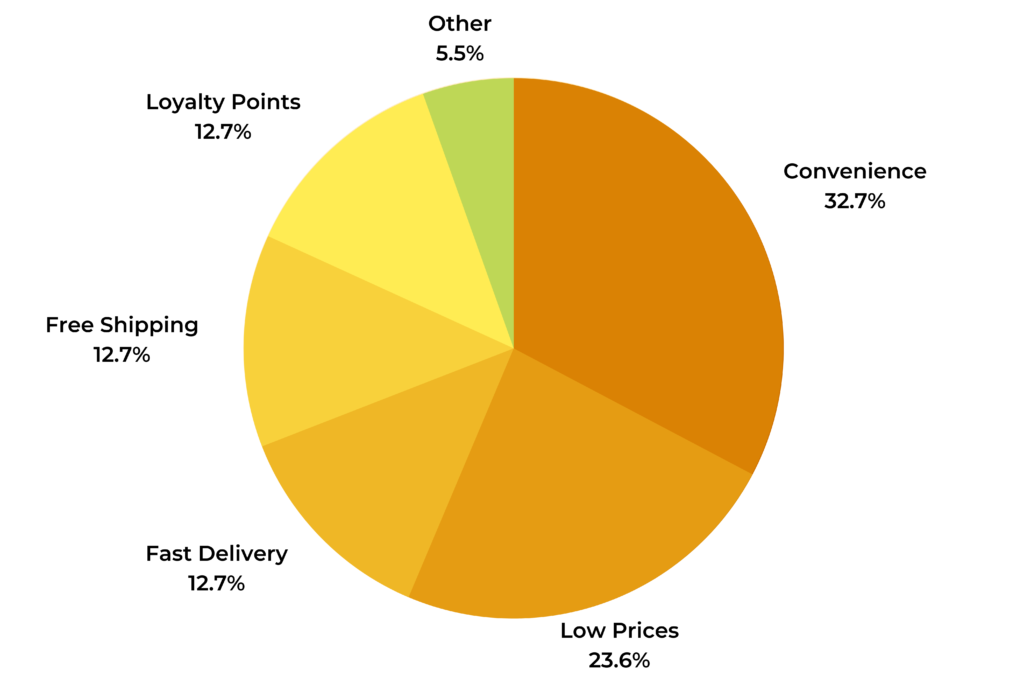
When stocking up on tried-and-true products, what makes a shopper choose i store or website over another? Some of the top reasons include convenience, low prices, free aircraft, fast delivery and loyalty points.
When consumers are stocking upwardly on their become-to dazzler products, they don't just take hold of what they need and head for the checkout.
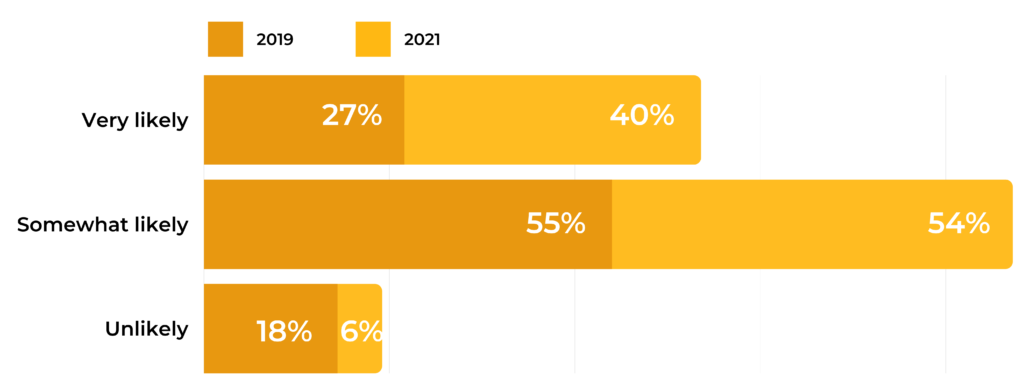
Instead, 94% of consumers say that when they're purchasing a habitual production, they're at least somewhat probable to also buy a new production during the same transaction. This is up from 82% when we asked the aforementioned question just a couple years ago.
Information technology seems today'south beauty shoppers are more than willing to try something new than they were just a few years ago — which we'll explore more in the next section.
How Consumers Discover New Beauty Products
Today, consumers are spending more than time at home. Many are using this equally an opportunity to do things they didn't have the time for before — like trying out new beauty products.
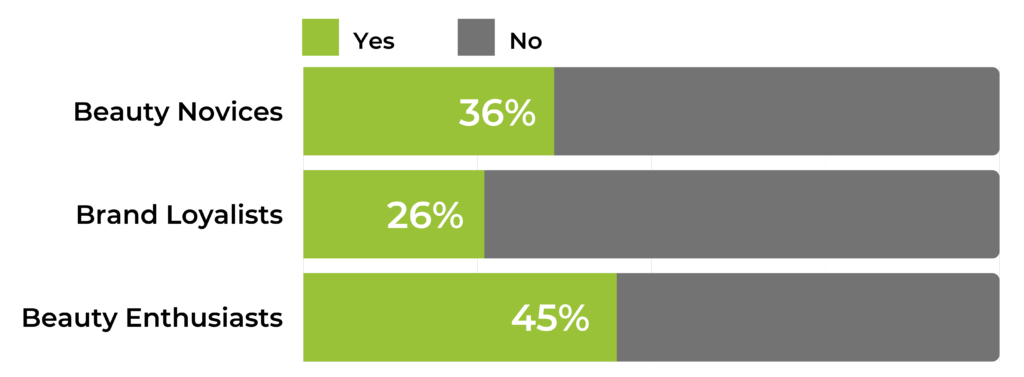
In fact, two in v (xl%) of those nosotros surveyed said they're more likely to try new-to-them beauty products now than pre-Covid. This number is fifty-fifty college for Millennials (46%) and Gen Z (53%). What's more, dazzler enthusiasts are more likely to try new beauty products (45%) than those who identify every bit beauty brand loyalists (26%) and beauty novices (36%).
Where are they shopping for these products? And what information do they depend on to make confident purchase decisions? Permit's take a closer wait.
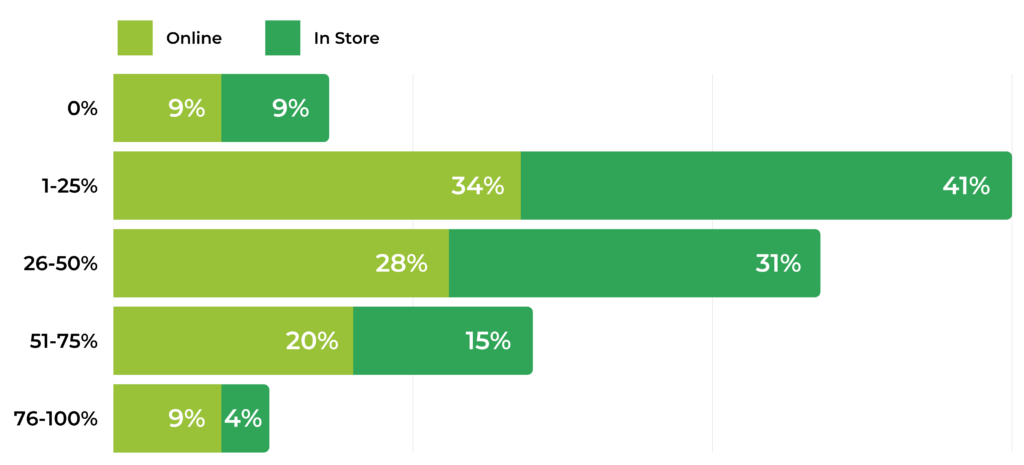
Whether they're shopping online or in-store, dazzler shoppers are spending a good chunk of their budget on products they've never tried before.
Of note, online shoppers are slightly more than likely to spend 51-100% of their budget on new products than those shopping in-shop.
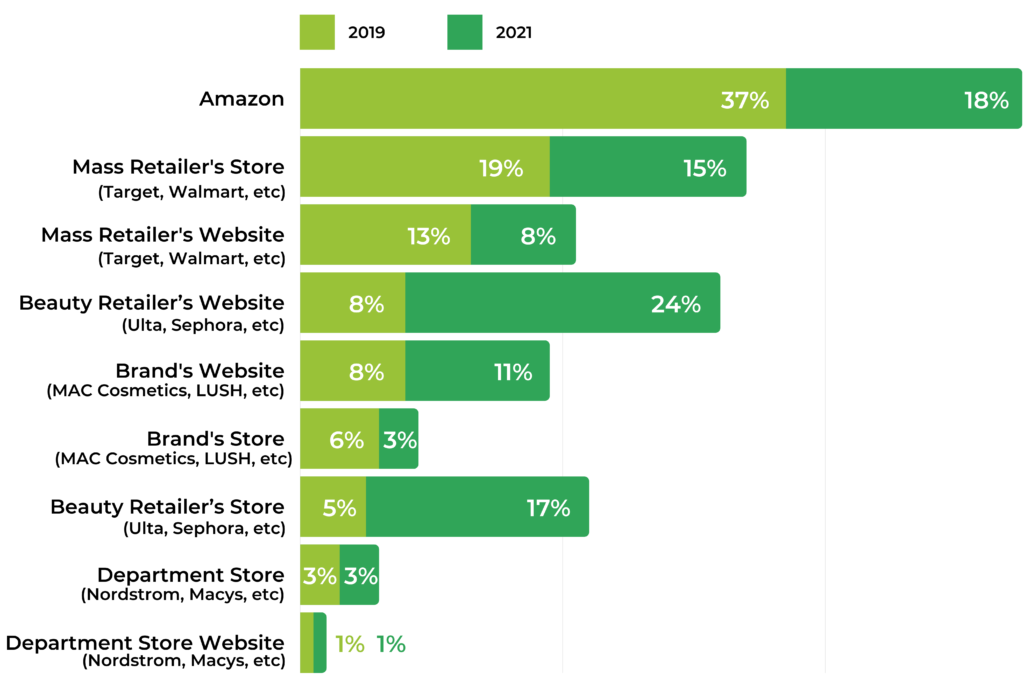
Where are consumers shopping for these new-to-them beauty products? The top five destinations for purchasing new beauty products are a specialty dazzler retailer's website (24%), Amazon (xviii%), a speciality beauty retailer's store (17%), a mass retailer'southward store (15%) and a brand website (11%).
Consequent with other findings in this survey, brand and specialty beauty retailer stores and websites are gaining traction when compared to our results from 2019 — with Amazon losing favor.
At that place'southward a sure level of risk associated with purchasing a production you've never bought before. So how do shoppers proceeds the confidence they need to buy new-to-them dazzler products?
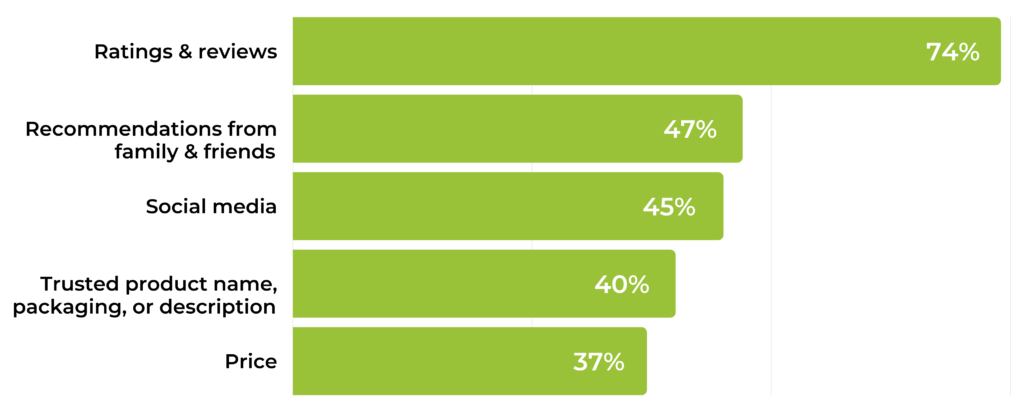
Three-quarters (74%) say ratings and reviews motivate them to try new beauty products. This number jumps to 79% for both Millennial and Gen Z beauty shoppers.
In fact, for all age groups, it seems this content is significantly more impactful than recommendations from family unit and friends (47%) and cost (37%)!
The Impact of Influencers on Shopping Behavior
Our survey found that nearly half (45%) of shoppers are motivated by social media to try new beauty products. This number is even higher for Millennials (52%) and Gen Z (63%).
So it makes sense that a growing number of brands are investing in influencer marketing. MediaKix predicts that brands will spend up to $fifteen billion on influencer marketing by 2022.
Just how exactly are beauty shoppers swayed by influencers? Let's explore.
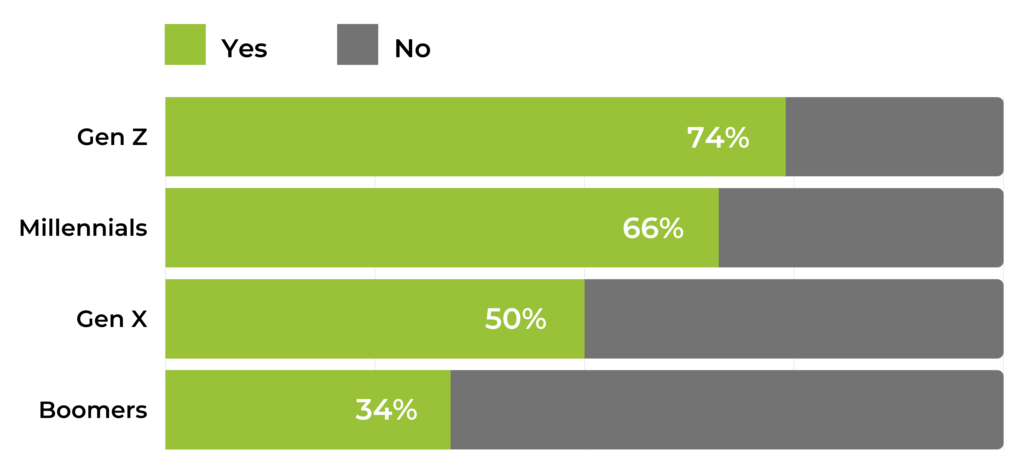
Over half (56%) of consumers say they are swayed by the influencers they follow to purchase beauty products. And younger shoppers are even more than likely to be influenced.
Three-quarters (74%) of Gen Z shoppers and 66% of Millennials say they are swayed to buy beauty products by influencers they follow.
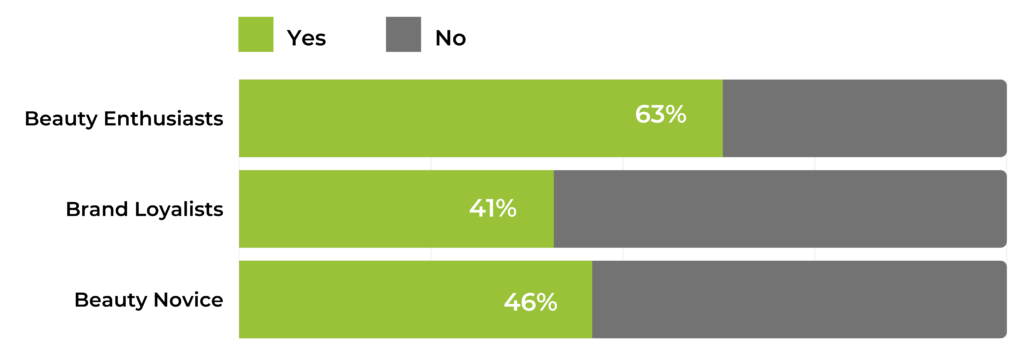
What's more, beauty enthusiasts are much more likely to be swayed by influencers than other types of dazzler shoppers. This makes sense, as those who identify as beauty enthusiasts are always on the scout for the next big thing.
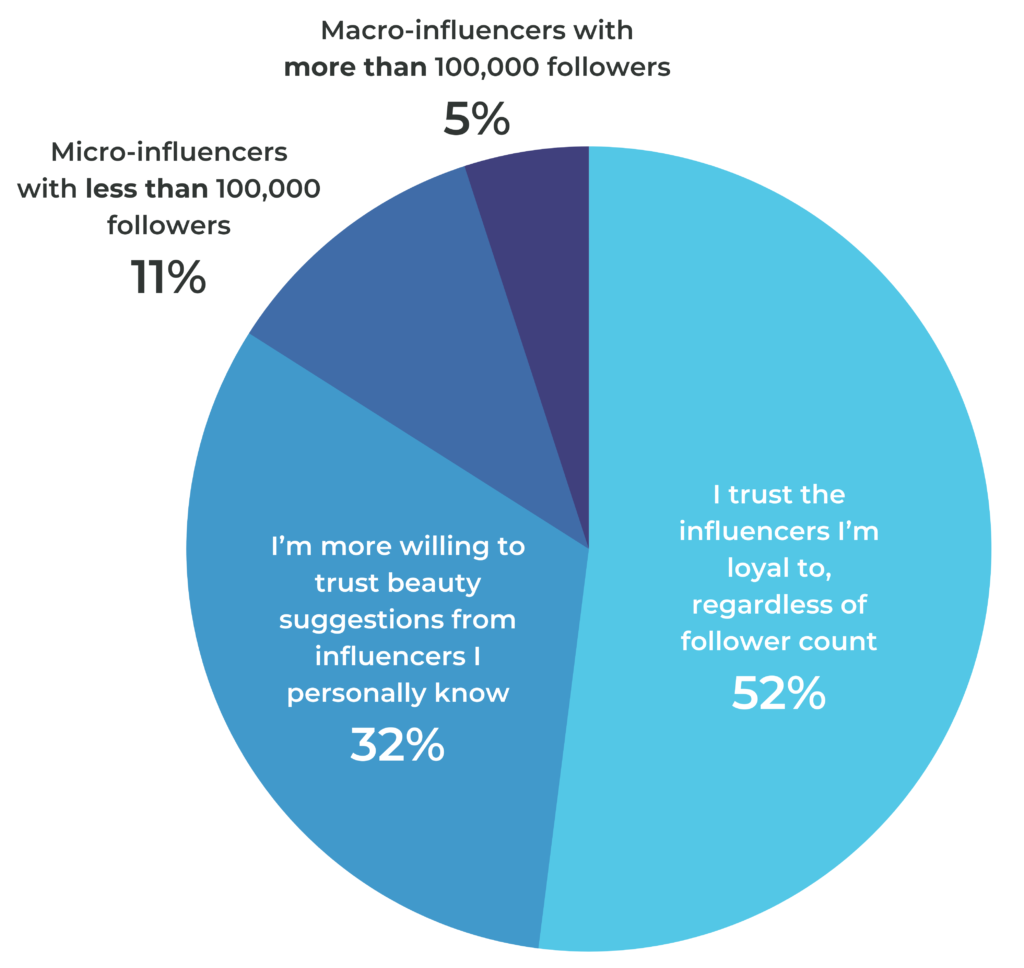
Does the number of followers an influencer has impact how much beauty shoppers trust them? For many, it doesn't.
Over half (52%) of consumers say they trust the influencers they're loyal to no affair their follow count.
A third (32%) say they're more willing to trust beauty suggestions from influencers they personally know, and 11% indicate they're more probable to trust micro-influencers with less than 100,000 followers.
Just five% of beauty shoppers say they near trust macro-influencers with more than 100,000 followers.
The Changing Priorities of Today'southward Beauty Shoppers
In the by, shoppers weighed factors like toll, brand and quality when choosing beauty products. Of course, these factors nevertheless affair. Simply increasingly, beauty shoppers besides seek out products and brands that align with their values.
For many, the land of the environment is a growing concern. Every bit such, an increasing number of shoppers are seeking out eco-friendly products and brands.
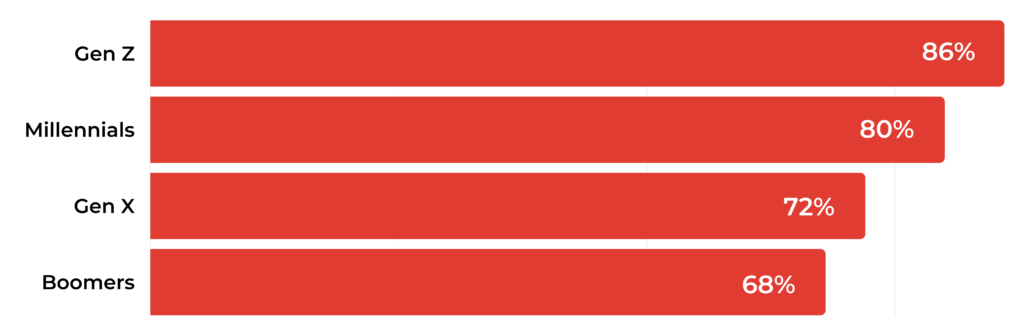
Beauty shoppers are no exception. More than three-quarters (76%) of shoppers program to buy beauty products in the futurity that are made sustainably.
Gen Z shoppers (86%) and Millennials (fourscore%) are even more likely to purchase sustainable beauty products.
In 2020, a growing number of consumers took action in the fight for racial justice. I mode consumers chose to support this cause was by seeking out and ownership from Blackness-owned businesses.
According to Yelp, from May 25 to July 10, 2020 there were more than ii,500,000 searches for Black-owned businesses — upwards 7,043% from the aforementioned flow in 2019.
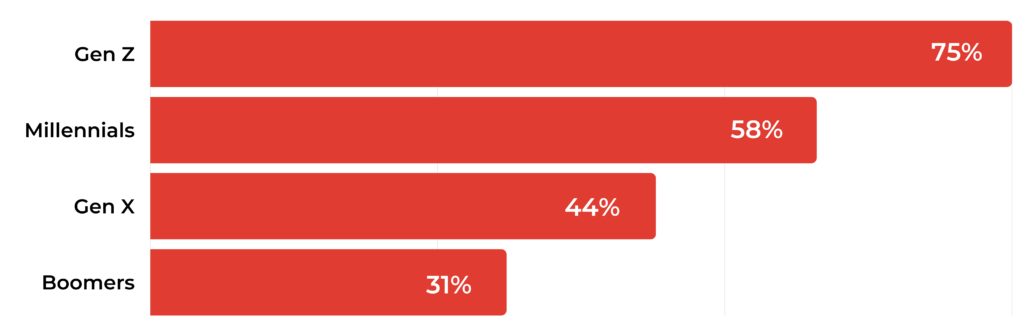
And then information technology may come as no surprise that half (50%) of consumers say they plan to actively seek out beauty products made past Black-endemic beauty brands. This number is even higher amid Gen Z (75%) and Millennials (58%).
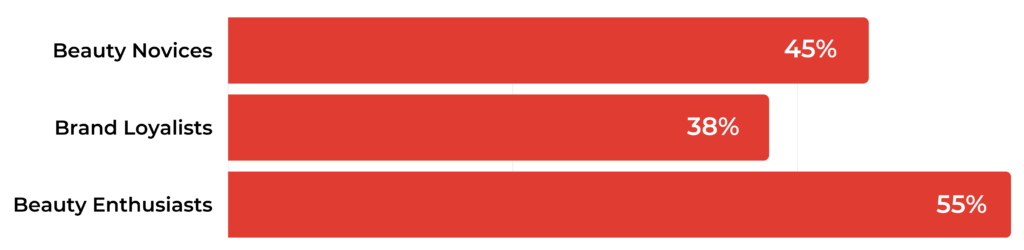
In addition, dazzler enthusiasts are much more probable to seek out Black-endemic beauty brands (55%) than beauty brand loyalists (38%) and novices (45%). That makes sense, as these shoppers are typically more open to trying out new products.
6 Recommendations for Dazzler Brands and Retailers
The way consumers shop for beauty products is evolving. And the COVID-19 pandemic has only sped up this evolution. Brands and retailers must adapt to meet and exceed the expectations of beauty shoppers — or take a chance losing them for expert.
Read on for half-dozen practical, impactful deportment to take, based on the fundamental findings of this report.
A growing number of consumers are shopping for beauty products online, especially in the midst of the COVID-19 pandemic. But at the same time, brick-and-mortar retail is still very much live and well. Exist sure you lot're providing great, seamless shopping experiences across channels. Call back: your shoppers should be able to find all of the data they need to brand smart purchase decisions — regardless of whether they're shopping online or in-shop.
Shoppers depend on reviews to brand informed buy decisions both online and in-store. And 41% of beauty shoppers rely on this content even more than now than pre-COVID. This number is even higher among younger shoppers. Recency, quantity and star rating all thing — then be sure to collect a steady stream of reviews on an ongoing basis. Finally, recollect that reviews motivate 3-quarters of shoppers to try new beauty products. So if yous're launching new products in the coming yr, consider sending out free samples in substitution for honest reviews.
Beauty products are highly personal. As such, shoppers want to run into how a product works (or doesn't) for someone with similar characteristics. User-submitted photos and videos permit them to do that. And over a third of beauty shoppers are more reliant on user-submitted visual content at present than they were pre-COVID. This number is even higher for younger shoppers. So be sure to collect and display photos and videos of your shoppers using your products "in existent life." Collect this content both natively and where information technology already lives: on social media.
A third of shoppers (and an even greater number of younger shoppers) rely on Q&A more now than they did pre-COVID. If yous don't have Q&A software on your product pages, now's the fourth dimension to add it. It'll help shoppers make smarter buy decisions — which will atomic number 82 to happier customers and fewer returns. Also, consider allowing previous customers to respond shopper questions. After all, consumers trust the opinions of others like them!
Influencers have the power to sway dazzler shoppers. But over half of beauty shoppers consider the number of followers an influencer has to be irrelevant. So recall about ways to leverage the micro-influencers who dearest your brand and products. For example, send samples to these everyday influencers, and in exchange, ask them to write an honest review. Or, ask them to post a photo of your production in action on their Instagram account — and so repurpose that content on your website.
Factors like toll and packaging are still important. Merely today, a growing number of beauty shoppers likewise want to purchase products that marshal with their values. Specifically, we plant that many shoppers are actively seeking out products that are sustainably made and created by Black-owned businesses.
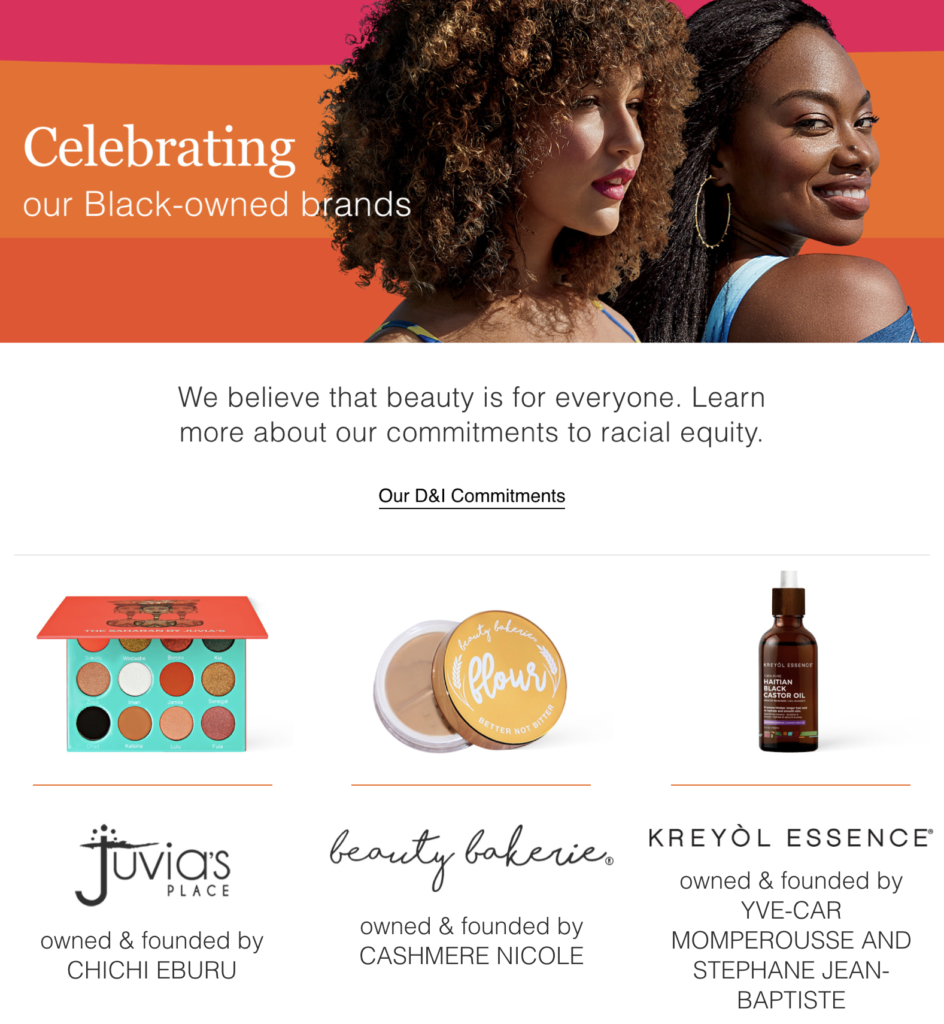
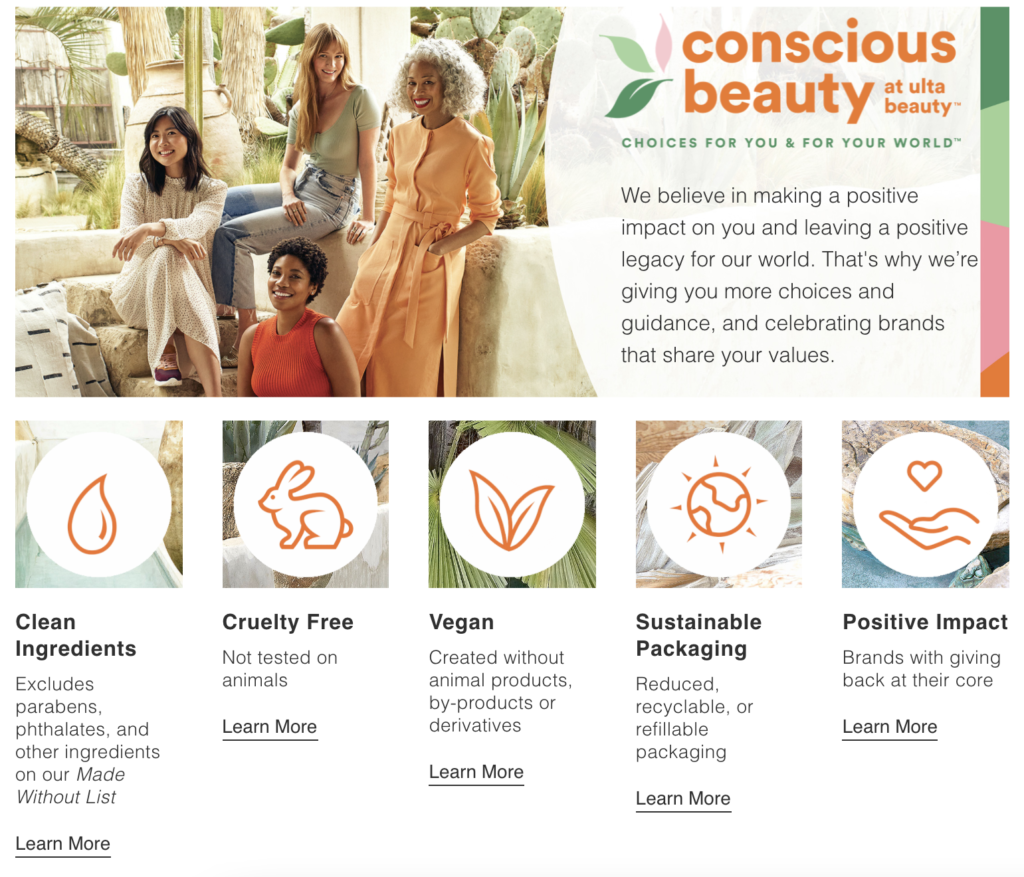
If at that place'south something unique most your brand or products, be sure to showcase it. Or if you're a dazzler retailer, make information technology easy for shoppers to find products that marshal to the things that matter most to them. For example, Ulta features sections on their website that make it easy for shoppers to find products from Black-owned brands — and those that are eco-friendly.
Source: https://www.powerreviews.com/insights/2021-beauty-industry-consumer-report/
Posted by: feldmanjudianob.blogspot.com













0 Response to "Do Millennials Want To Buy Cheap Makeup?"
Post a Comment